
The Acorn Archimedes arrived in 1987 carrying the first commercially available ARM processor — then standing for Acorn RISC Machine — running at 8 MHz and delivering performance that embarrassed the 68000-based competition. Paired with RISC OS and BBC BASIC V, it gave hobbyist programmers a structured, expressive language with optional inline 32-bit ARM assembly, direct OS calls, and graphics primitives powerful enough to fill a high-resolution screen in real time. ArchBAS is a repository of experiments and demos written specifically for this machine, exploring what BBC BASIC V can do when pushed hard against the Archimedes hardware.
BBC BASIC V on ARM
BBC BASIC on the Archimedes is far more capable than most people realise. Unlike the 6502 dialect on the BBC Micro, BBC BASIC V runs on a 32-bit RISC processor with no artificial memory ceiling, giving it access to floating-point arithmetic at full precision, fast integer multiply and divide, and the ability to inline ARM assembly directly within BASIC listings using the built-in assembler. The PLOT and MOVE commands drive the Archimedes VDU system for graphics output, exploiting the hardware's multiple screen modes for crisp, high-resolution results. PROC and FN constructs keep the code structured and readable — these are properly factored routines, not spaghetti GOTO programs.
Schraf Graphical Demos
The current centrepiece of the repository is the Schraf graphical demo collection, a set of mathematical visualisation programs ported from QB64 originals by Eric Schraf. Each demo renders a different kind of generative geometry entirely in BBC BASIC — no assembly, no external libraries, just the BASIC interpreter doing floating-point trigonometry, iterative plotting, and real-time screen updates. The Archimedes's fast ARM core churns through thousands of iterations per frame in a way a 1 MHz 6502 could only dream about.
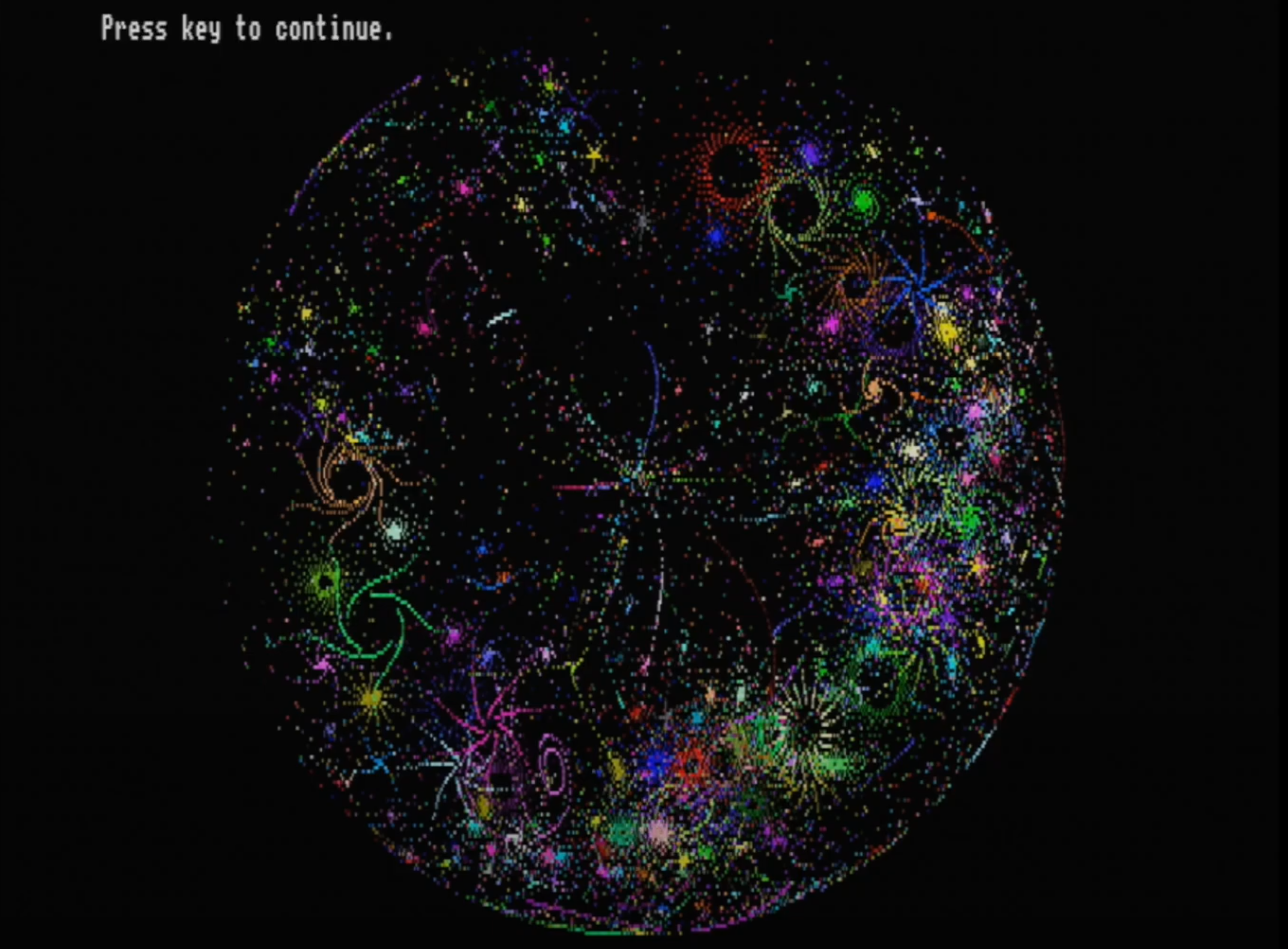
The Bubble Universe demo generates its signature interference patterns by iterating a simple two-variable recurrence relation and plotting each resulting point. Field Lines traces electromagnetic field line paths through a simulated charge distribution. Mathematical Hat renders a 3D parametric surface projected onto the 2D screen using rotation matrices computed entirely in BASIC.


The Event Horizon and Galaxy demos push the visual complexity further, generating spiral arm structures and accretion-disk-like gradients that highlight the ARM's ability to sustain high-throughput floating-point computation.


Christmas Tree
Alongside the mathematical demos, the repository also includes a Christmas Tree program, a festive graphical display originally shared in the Acorn community by Aurel Wizzard. It demonstrates a different side of BBC BASIC on the Archimedes: tight, playful code that produces a surprisingly charming seasonal image with minimal line count.

Downloads
Both tokenised (compiled) and human-readable source files are included for every program. The tokenised format runs at maximum speed on real Archimedes hardware or an emulator, while the source listing lets you read, modify, and learn from every line. The full repository with all source and tokenised files is available at https://github.com/xahmol/ArchBAS.